Turkish President’s Visit to Seoul Focuses on Strategic and Commercial Partnership
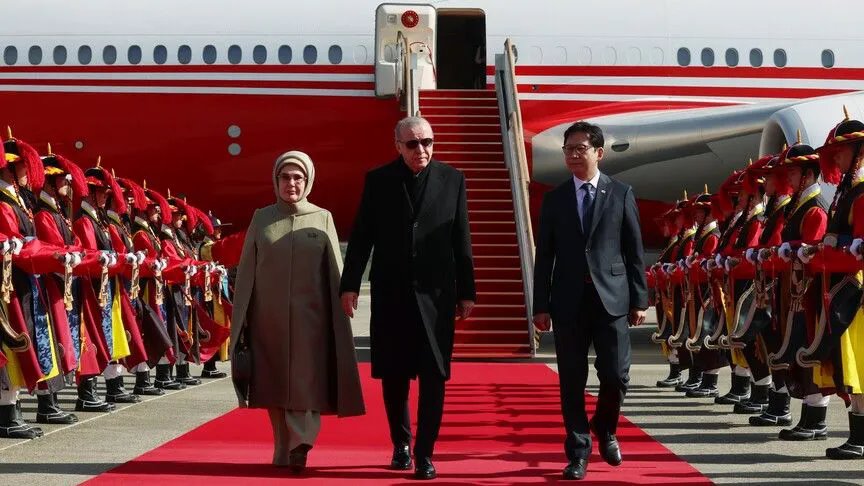
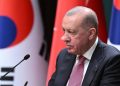
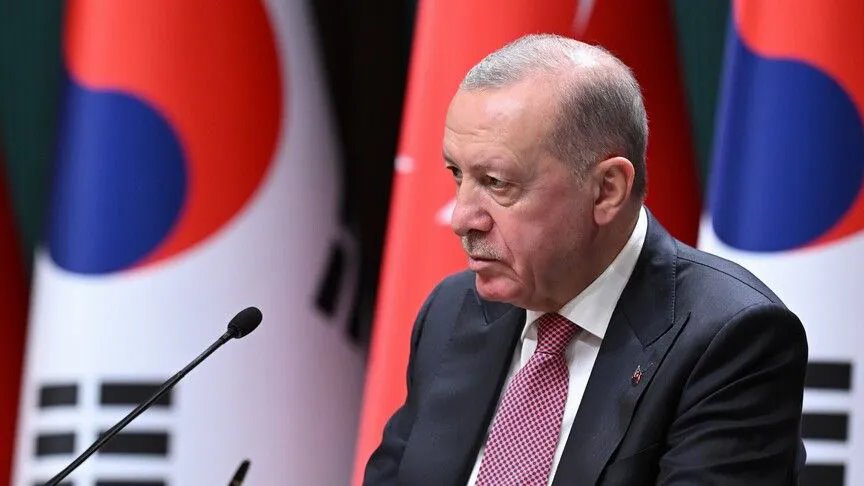
Turkish President Recep Tayyip Erdogan arrived in Seoul in response to the official invitation of South Korean President Lee Jae Myung. Erdogan and his wife Emine Erdogan were welcomed at Seongnam Air Base in Seoul by South Korean Trade Minister Park Jong Sung. Turkey’s Ambassador to Seoul, Fatih Yildiz, and his wife Nesrin Yildiz also attended the welcoming ceremony.
Erdogan is accompanied on this visit by Foreign Minister Hakan Fidan; Minister of Energy and Natural Resources Alparslan Bayraktar; Minister of National Defense Yasar Guler; Minister of Industry and Technology Mehmet Fatih Kacir; Deputy Chairman of the Justice and Development Party Halid Yerebakan; and Head of the Defense Industry Agency Haluk Gorgun.
Emphasizing the importance of strengthening political and economic relations between Ankara and Seoul, the Turkish President announced that his country seeks to increase cooperation in the fields of defense industry, nuclear energy, advanced technologies, artificial intelligence, and renewable energy and to reach a bilateral trade volume of 15 billion dollars. He described the priority of his visit as strengthening bilateral dialogue and accelerating the economic relations of the two countries, and said that by bringing together South Korea’s experience and capacity in technology and innovation with Turkey’s production power, the two countries can achieve greater accomplishments.
Referring to the strong historical foundations of friendship between Turkey and South Korea, Erdogan noted that this friendship was formed during the difficult days of the Korean War and has maintained its value and validity after decades. According to him, brotherhood and mutual trust have been the basis of relations between the two countries since then, and transferring this heritage to future generations with greater strength is a duty for both countries.
Referring to important opportunities in the fields of defense industry, nuclear energy, advanced technologies, artificial intelligence, and renewable energy, the Turkish President stated that he intends to turn these opportunities into concrete projects, expand the field of activity of companies from the two countries, and increase mutual investments. He considered reaching a bilateral trade volume of 15 billion dollars as the goal of the two countries and described creating more balance in trade, increasing investments, and closer cooperation in the field of production as important for achieving this goal.
Erdogan also emphasized the importance of ongoing talks with South Korea regarding the Sinop Nuclear Power Plant project and said that Ankara is aware of the Koreans’ experience in the field of nuclear energy. He added that after the signing of the memorandum of understanding last year, important steps have been taken with KEPCO within the framework of preliminary feasibility studies, and assessments regarding the technical and economic conditions of the project and the investment model continue. According to him, the cost of electricity production, the financing method of the investment, and the project’s achievements for the Turkish economy will be determining factors in the final decision, and all options will be evaluated in line with Turkey’s interests.
Referring to the imbalance in bilateral trade, the Turkish President said that in 2025 Turkey’s exports to South Korea were about 1 billion and 140 million dollars and its imports were 10 billion and 260 million dollars, and Ankara wants to reduce this difference and give the trade between the two countries a more balanced and sustainable structure. He described Turkey’s strong production infrastructure, skilled workforce, and strategic position as important opportunities for South Korean investors and cited Hyundai’s rooted activity in automobile production and POSCO’s investment in the steel sector as concrete examples of cooperation between the two countries. Erdogan also welcomed the start of electric vehicle production at Hyundai’s facilities in Izmit.
Referring to opportunities in the fields of electronics, semiconductor technologies, machinery and industrial automation, robotic systems, biotechnology, pharmaceuticals and medical equipment, and renewable energy, he called for increased investment by South Korean companies in Turkey and the creation of stronger partnerships with Turkish companies. He emphasized Turkey’s desire to achieve more concrete results in the field of joint production and technology development.