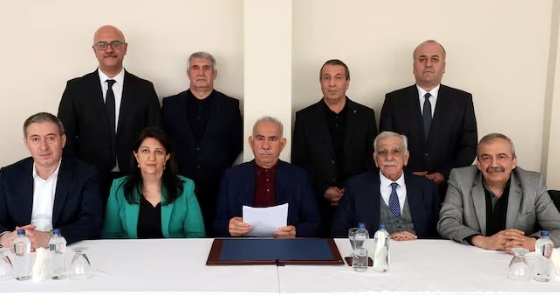
In a significant development, Abdullah Ocalan, the imprisoned leader of the PKK, called on members of the organization to lay down their weapons and disband the organization forever. The message, read at a news conference in Istanbul last week, could mark a turning point in the long-running conflict between the PKK and the Turkish government.
Ocalan’s appeal, read out by a representative of the Peoples’ Equality and Democracy Party, a party close to the PKK, contained these key phrases: “I call on the PKK to hold its extraordinary congress and decide to integrate into the government and society like modern political parties. All armed groups must lay down their weapons and the PKK must also be disbanded.”
Ocalan’s request comes at a time when political observers consider it an important step towards resolving one of the most complex conflicts in the Middle East.
Describing the establishment of the PKK as “an important stage in the struggle of the Kurdish people,” Ocalan acknowledged that times had changed and the demand for an independent Kurdistan or even autonomy was no longer viable. In his opinion, the main priority is to strengthen democracy and political pluralism within the framework of the Republic of Turkey.
A possible reconciliation between the PKK and Ankara could lead to significant geopolitical changes in the region. The presence of the PKK in northeastern Syria and the control of large parts of this region by the Syrian Democratic Forces have always been viewed as a threat by Turkey.
The Turkish Foreign Minister has announced that Ankara may review its military presence in northeastern Syria if the PKK’s presence in the region is eliminated.
Furthermore, the dissolution of the PKK could lead to greater convergence among the various Kurdish groups in Syria and possibly an agreement with the central government in Damascus. In Iraq, the Kurdistan Region, which has close relations with Ankara, could play an important role in this process.