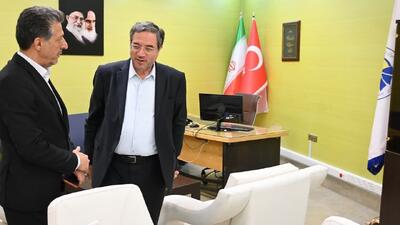
The office of the Iran-Turkey Chamber of Commerce was inaugurated in Urmia
The office of the Iran-Turkey Joint Chamber of Commerce was inaugurated on Wednesday at the Urmia Chamber of Commerce, with the aim of organizing commercial activities and enhancing economic exchanges between the two countries.
This ceremony was held in the presence of the governor of West Azerbaijan, members of the board of representatives of the Urmia Chamber of Commerce, Industries, Mines, and Agriculture, as well as a group of merchants, traders, and economic activists.
The inauguration of this office is considered an important step towards facilitating trade and strengthening economic cooperation between Iran and Turkey.
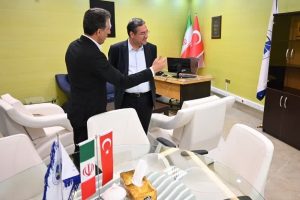
The governor of West Azerbaijan, Reza Rahmani, announced on Wednesday at the inauguration ceremony of the Iran-Turkey Joint Chamber that strengthening border cooperation is one of the government’s priorities, and the opening of this office is considered an important step in the development of bilateral relations.
Emphasizing the importance of economic relations with Turkey, he stated that this province is recognized as Iran’s commercial gateway to Turkey, and the government supports any measures that contribute to the improvement of border and trade infrastructure.
Mehrdad Saadat, the president of the Iran-Turkey Joint Chamber of Commerce, also stated at the ceremony that the current volume of trade between the two countries does not correspond to the existing capacities.
He added that Iran has many goods with export advantages to Turkey, but trade barriers must be removed. The Iran-Turkey Joint Chamber of Commerce, with more than 1,700 active members, can play a key role in this regard.
Saadat also noted that the Urmia Chamber of Commerce, as the representative of the private sector in West Azerbaijan, will play an important role in developing trade with Turkey and removing trade barriers.
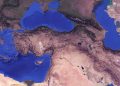
West Azerbaijan Province shares more than 1,000 kilometers of border with Turkey, Iraq, and the Autonomous Republic of Nakhchivan. This border capacity has contributed to the development of trade and cultural relations between these countries and the Islamic Republic of Iran.