The geopolitical role in the Turkish-Israeli military-political competition in post-Assad Syria
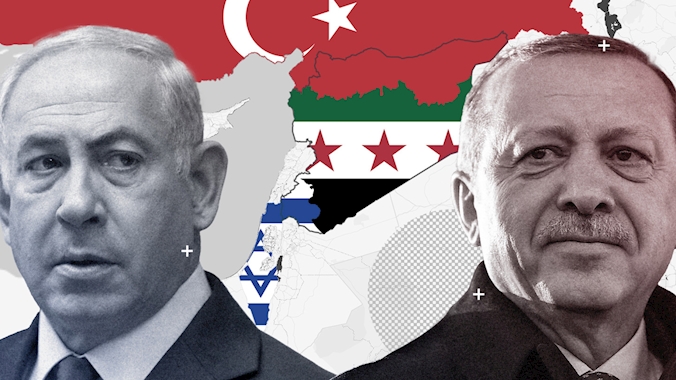
With the shift in power dynamics in Syria following the decline of Bashar al-Assad’s regime and the rise of a transitional government, the geopolitical landscape of the region has witnessed complex maneuvers among regional and international actors. In this context, Turkey and Israel, with differing yet overlapping security and strategic objectives, play significant roles in Syria’s future—one in the north and the other in the south. The key point is that the interactions between these two countries within the Syrian theater reflect a competition that could lead to limited cooperation or even tactical alignment.
On one hand, Turkey seeks to prevent the formation of an autonomous Kurdish region in northern Syria—an area it views as a serious threat to its territorial integrity. On the other hand, Israel aims to establish a “security buffer zone” in southern Syria to counter Iranian influence. This competition has manifested not through direct warfare, but rather through military influence, restructuring local governance, and controlling airspace.
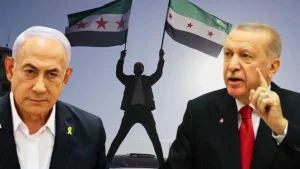
The Kurds, as one of the most significant non-state actors, stand at the intersection of Turkish-Israeli tensions. While Turkey views the Syrian Democratic Forces (SDF) as an extension of the PKK, Israel strategically supports the Kurds as a counterbalance against Iran. This divergence in perspectives has effectively hindered any potential alignment between Ankara and Tel Aviv.
Moreover, although Russia’s military presence has diminished in recent months, Moscow remains a key player through the Hmeimim airbase and its influence within Syrian security institutions. Russia will likely continue balancing between Turkey and Israel with a “divide and rule” strategy.
Amid these tensions, despite their differences, countering Iranian influence and its affiliated militias—along with preventing sectarian separatism within the Syrian army—could create potential areas of cooperation. However, such cooperation would depend on external variables, including U.S. policies and domestic developments in both countries.
At a deeper level, Turkey and Israel also compete over control of Syria’s energy resources and trade corridors. Eastern Mediterranean gas projects and energy transit routes could shift this rivalry into the economic sphere.
In summary, Syria is becoming a complex arena of competition between Turkey and Israel—a rivalry that began with military tools but will soon extend to economic, political, and intelligence dimensions. While direct conflict between the two remains unlikely, failure to manage this competition could plunge Syria into a new phase of instability. The future of Syria and the regional order hinges on whether these two key players can bring their rivalry to a predictable and manageable level—or whether tensions will escalate further toward crisis.