Özgür Özel’s Reaction to Trump’s Peace Plan for Gaza
Following the meeting between Donald Trump, President of the United States, and Benjamin Netanyahu, Prime Minister of Israel, at the White House, Washington unveiled a twenty‑point plan entitled “Trump: Ending the Gaza War.” The plan envisions the creation of a non‑political Palestinian committee to temporarily administer Gaza and the deployment of an international force called the “Stability Force.” The text of the plan emphasizes that Israel will neither occupy Gaza nor annex it to its territory.
At a joint press conference with Netanyahu, Trump described the initiative as “a historic day for peace” and announced that he had shared it with leaders of Arab and Islamic countries, including Saudi Arabia, Jordan, Turkey, Egypt, Pakistan, Qatar, and the United Arab Emirates. He also spoke of support from European allies and warned that if Israel failed to reach an agreement with Hamas, the United States would back Israel in the “complete elimination of the Hamas threat.” Netanyahu likewise described the plan as a vital step toward ending the Gaza war and laying the groundwork for comprehensive peace in the Middle East.
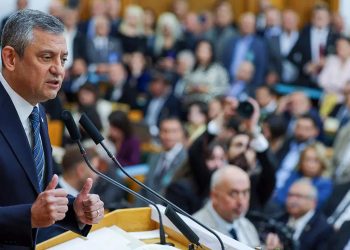
In response to the announcement, Özgür Özel, leader of Turkey’s Republican People’s Party (CHP), issued his first official reaction on social media. In his statement, he stressed that Turkey must assume responsibility for safeguarding peace and that his party welcomed the country’s participation in the peacekeeping force. Özel warned that acceptance of the plan by Hamas was essential for its success; otherwise, there was a risk of renewed conflict. He also noted that certain hardline factions within Netanyahu’s cabinet could obstruct the plan’s implementation and complicate the peace process.
The CHP leader further referred to the involvement of Tony Blair, former Prime Minister of the United Kingdom, in the peace delegation, criticizing the fact that the plan had been drafted without consulting the Palestinians and that the role of the United Nations had been reduced to humanitarian assistance. He described Blair’s appointment—given his past support for the invasion of Iraq—as controversial, adding: “This is not a just peace, but a bad peace is better than perpetual war.”
In another part of his statement, Özel recalled the CHP’s general stance, noting that the party had consistently and resolutely supported the Palestinian cause and had voiced the strongest reactions to the humanitarian catastrophe in Gaza. Pointing out that nearly one hundred people, including women and children, lose their lives daily in Palestine, he emphasized that his party welcomed a ceasefire in Gaza and the rescue of innocent civilians from what he called “Israel’s genocide.” Özel added that the withdrawal of the Israeli army, prevention of Gaza’s annexation, entry of humanitarian aid, prohibition of the forced displacement of Palestinians, and the possibility of refugees returning were among the measures supported by the CHP.
In conclusion, Özel underlined that two fundamental principles must be observed in resolving the Palestinian issue: first, Palestinians must be included in every decision‑making process regarding their future; and second, no process should obstruct the realization of the two‑state solution. He reiterated that the only sustainable resolution to the Israeli‑Palestinian conflict is the establishment of two independent states based on United Nations resolutions.